08 October 2026
Aerial Crop Spraying: What Farmers Should Know Before Going Digital
Presented by @csds5pqyyc
Why Farmers Are Rethinking How Spraying Gets Done
There is a quiet shift happening on farms across the UK. Walk into any agricultural show or read through a farmers' magazine and you will see it: the growing interest in aerial crop spraying. It is not just about novelty or keeping up with technology. For many growers, it is becoming a practical answer to a very old problem - how to get the right input in the right place at the right time, without wasting product or damaging the soil.
I have spent the last few seasons watching this technology mature, and I have to say, the progress is real. The early days of drones in farming were mostly about taking pretty pictures from above. Now, the conversation has moved on to application. We are talking about agricultural drones carrying spray systems, spreading granules, and even sowing seeds. The leap from photography to application is a big one, and it brings with it a whole new set of decisions.
The Practical Promise of Drone Spraying
When people ask me why they should consider drone spraying, I usually start with the obvious: access. There are fields that are simply not friendly to a 24-metre sprayer. Wet patches, steep slopes, late-season crops that you do not want to flatten. A quad bike with a knapsack sprayer is slow, uncomfortable, and honestly, not that accurate. A drone, on the other hand, can fly over the crop without ever touching it. That means you can do crop protection work when the ground is too soft to travel, or when the crop is too tall to drive through without causing damage.
But access is only part of the story. The real value lies in precision. With GPS guidance and field mapping, a drone can be programmed to follow the exact shape of a field, including all its awkward headlands and obstacles. It can vary the rate of pesticide application or fertiliser spreading based on a prescription map. That is variable rate application in its truest form. You are not just covering the ground evenly; you are covering it intelligently.
What It Feels Like to Fly a Spraying Mission
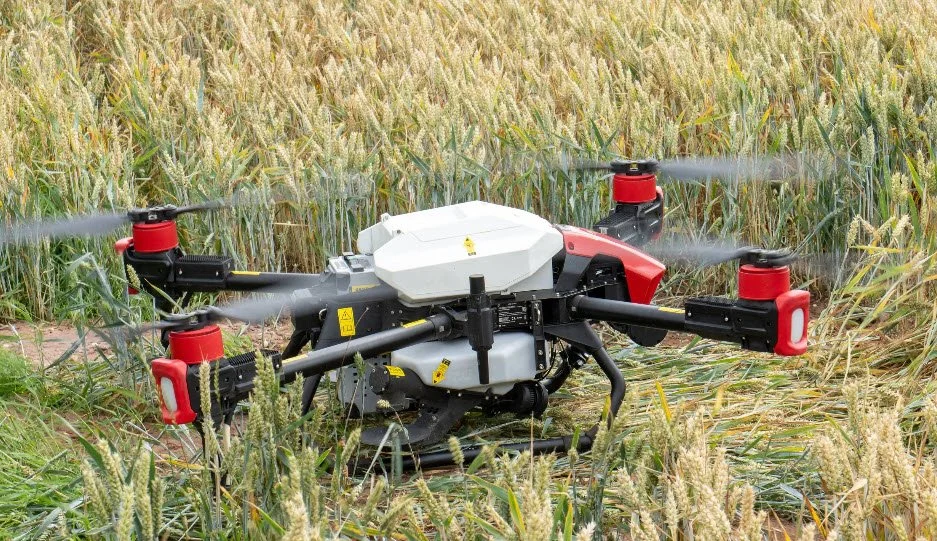
If you have never flown a spraying drone, the experience is surprisingly hands-on. You set up the mission on a tablet, mark the field boundaries, and let the software work out the flight lines. The drone takes off, follows its route, and returns when the tank is empty or the battery is low. You refill, swap batteries, and send it out again. It is not glamorous, but it is efficient. A machine like the DJI Agras can cover several hectares in an hour, depending on the crop and the product being applied.
What strikes me most is how quiet the whole operation is. Compared to a tractor, the drone is almost silent. You can work early in the morning or late in the evening without disturbing anyone. That matters when you are spraying near houses or livestock. It also means you can take advantage of calm conditions, which are often at dawn and dusk, when the wind is low and drift is less of a concern.
Where Aerial Crop Spraying Fits on the Farm
Let me be clear: aerial crop spraying is not a replacement for a conventional sprayer. It is a complement. There will always be jobs that are better done with a tractor-mounted boom, especially on large, flat fields where the economics of scale kick in. But there are specific situations where a drone genuinely shines.
- Spot treatments for weeds, pests, or disease, where only part of the field needs attention.
- Late-season applications when the crop is too tall to drive through without lodging.
- Small or awkward fields that are difficult to access with ground equipment.
- Areas near watercourses where precision is critical to avoid runoff.
- Cover crops or catch crops that are sown after harvest, often on wet ground.
Each of these scenarios plays to the strengths of Unmanned Aerial Vehicles. They are agile, they are precise, and they do not compact the soil. That last point is often overlooked. Every time you drive a heavy machine across a field, you are compacting the soil, which affects root growth and water infiltration. Drones eliminate that entirely.
The Agronomy Behind the Flight
Precision agriculture is not just about the hardware; it is about the data. Before you even consider spraying, you need to know what is happening in the field. That is where remote sensing and field mapping come in. A drone equipped with a multispectral camera can pick up stress in the crop that the naked eye cannot see. It might be a lack of nitrogen, an early sign of disease, or a patch of weeds that is starting to take hold. Once you have that map, you can decide exactly where to apply the product and at what rate.
This is where the agronomy gets interesting. Instead of treating the whole field uniformly, you are targeting only the areas that need it. That means less agrochemicals in the environment, lower input costs, and better crop yield. It is a win-win, but it requires a shift in mindset. You have to trust the data and be willing to act on it.
Regulations and Safety: The Boring but Vital Stuff
No honest discussion of aerial crop spraying would be complete without mentioning regulations. In the UK, the Civil Aviation Authority (CAA) sets the rules for drone operations. If you are flying for commercial purposes, you need the right permissions and training. The rules are not just about where you can fly; they cover pilot competency, aircraft maintenance, and record keeping. It is not as simple as buying a drone and heading out to the field.
In the United States, the FAA regulations are similarly strict, and they have shaped how drone spraying has developed there. The point is that this is a serious operation, not a toy. You need to understand the weather, the airspace, and the product you are applying. You also need to think about drift. Even with the best GPS guidance, a sudden gust can move the spray off-target. That is why professional operators check wind speed and direction before every flight and use nozzles that produce the right droplet size for the job.
The Machines Themselves
When people talk about spraying drones, two names come up again and again: the DJI Agras and the Yamaha RMax. The RMax has been around for a long time and has a proven track record, especially in rice farming in Japan. It is a larger machine, more like a small helicopter, and it can carry a bigger payload. The Agras is more recent, but it has quickly become popular because of its ease of use and the support ecosystem around it.
Both machines have their place. The choice depends on the size of your operation, the crops you grow, and your budget. A smaller farm might find the Agras more than adequate. A large arable enterprise might look at the RMax or even a manned helicopter for the biggest jobs. The technology is not one-size-fits-all, and that is a good thing.
The Environmental Angle
One of the most compelling arguments for aerial crop spraying is its environmental impact. Because you are applying products more precisely, you use less of them. That means fewer chemicals in the soil and water, and less risk to beneficial insects and wildlife. It also means less fuel burned, since you are not driving a tractor back and forth across the field. Over a season, that adds up to a meaningful reduction in carbon emissions.
There is also the matter of timing. With a drone, you can respond quickly to a pest outbreak or a disease threat. You do not have to wait for the ground to dry out or for a contractor to become available. That speed can be the difference between a minor problem and a major loss. In that sense, drone spraying is not just about precision; it is about resilience.
Getting Started: What to Think About
If you are considering adding drone spraying to your operation, my advice is to start small. Do a few trials on a field that you know well. Compare the results with your usual method. Look at the cost per hectare, the time saved, and the quality of the application. Talk to other farmers who have used the service. And above all, work with a provider who understands agronomy, not just technology.
The best operators will spend as much time talking about crop growth stages and nozzle selection as they do about flight controllers. That is the kind of person you want on your side. They will also be honest about the limitations. There are days when it is too windy to fly, and there are products that are not suitable for aerial application. A good provider will tell you that upfront.
In the end, aerial crop spraying is another tool in the toolbox. It is not a magic bullet, but it is a genuinely useful one. As the technology improves and the regulatory environment becomes clearer, I expect to see more farms adopting it. The ones that do will likely find that it saves them time, money, and a bit of wear and tear on both their machinery and their fields. And that is a good trade-off in my book.